Trees contacting power lines can cause power outages, fires and other dangerous hazards. Risks increase when lightning, ice or high winds occur. For safety, reliability and compliance with the National Electric Safety Code, we prune or cut down trees that threaten electric service. Each year, we schedule areas that require trimming and adjust as needs change throughout the year. Our trimming ensures adequate separation between trees and power lines to maintain safety and service.
Inspections
If you are concerned about trees making contact with power lines, call us to have a forester visit and determine whether trimming is needed:
800-242-9137
Also call us if you or someone else is considering trimming or removing a tree near a power line. Review our guidelines:
Power line tree trimming safety
Our trimming practices
How and when we trim depends on the type of line. Other lines share utility poles, including electric, cable and phone.
Utility pole service line diagram
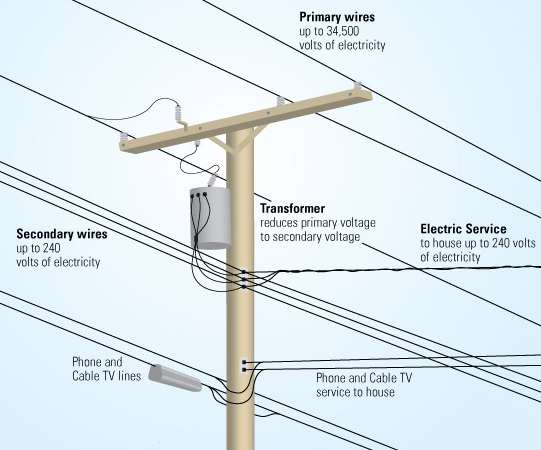
- Service lines: These wires are designed to be more resistant to tree contact and only need attention if branches prevent the wire from hanging freely. Before you or your contractor trim or remove trees close to service lines (pole-to-home wires), call 800-242-9137 to ask us to turn to ask us to turn off power. We turn off electricity temporarily and restore it when your work is complete — at no charge.
- Primary lines: Primary lines (pole-to-pole wires) cannot be removed from service temporarily because they serve many customers. In these cases, we have Asplundh, our tree trimming contractor, trim your tree only to make it safe. Once safe, our work stops, and you or your contractor take over.
Note: Our make-safe work can generate large amounts of wood and brush. You should plan for handling this material when you take over the remainder of the work. We recommend close coordination of our trimming with yours to minimize the time that brush and wood remain on your property.
- Phone and cable lines: Phone and cable companies maintain their lines on our poles. Contact your phone or cable company for assistance.
Directional pruning
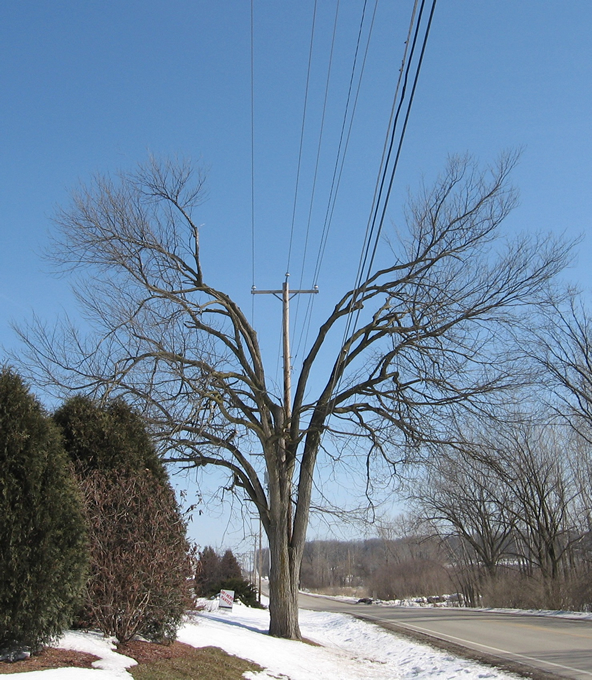
Directional pruning removes entire branches and limbs from tree trunks. This technique directs future growth away from power lines, reduces regrowth and protects trees from decay while preserving as much beauty as possible. The image below shows a tree with directional pruning.
Tree topping
We avoid tree topping because trees can regain original height, and fast-growing sprouts are susceptible to breakage and storm damage.
Species and location of trees
All trees are pruned back to existing tree lines. If no tree line exists, trees are classified as either slow-growing or fast-growing and pruned as follows:
- Slow-growing: Pruned to provide at least 6 feet of clearance from side of line.
- Fast-growing tree: Pruned to provide 10 feet of clearance from side of line.
- Limbs hanging over lines: Pruned to provide 20 feet of clearance above line.
Trees that must be cut down
In some situations, we must cut down trees.
- Tall-growing trees smaller than 12 inches in diameter within 10 feet of a high-voltage primary line will be cut down.
- Hazardous, diseased, structurally weakened or leaning trees that pose an imminent threat to lines will be cut down, and debris will be left on site.
- Trees that have caused repeated safety problems or power outages will be cut down.
- Trees will be cut as close as possible to grade.
- Stumps and young, tall-growing trees will be treated with an herbicide to prevent regrowth. (Note: Stumps will not be removed.)
Tree trimming questions and answers