Your energy bill has information to help you understand your energy use, billing and payment. The sample bill below highlights each section.
Sample bill
View larger sample bill image
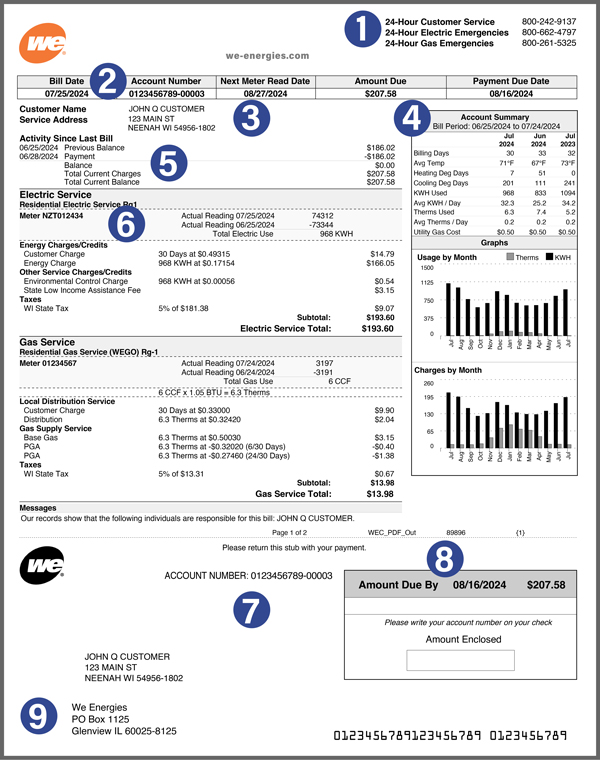
Bill sections
1. Important phone numbers
Important phone numbers: Numbers to connect with Customer Service, make payments, and report electric or natural gas emergencies.
2. Bill date, account number, next meter read date, amount due and payment due date
Bill date: Date your bill was generated.
Account number: Your unique customer identification number. You need this number when contacting Customer Service or signing up for My Account and/or our app.
Next meter read date: When we will read your meter to generate following month’s bill.
Amount due: Amount owed to We Energies for service provided during billing period.
Payment due date: Date your payment is due.
Payment transfer date: For customers using Automatic Payment, date payment will be withdrawn from bank account.
3. Customer name and service address
Customer name: Primary account holder.
Service address: Location where electric, natural gas or steam service is provided.
4. Activity since last bill, including previous balance and payment, and current charges and balance
Previous balance: Remaining amount owed or balance carried over from previous billing period.
Payment: Amount paid last billing period.
Balance: Difference between the previous balance and payment.
Total current charges: Total amount charged for current billing period.
Total current balance: Sum of balance (if applicable) and total current charges.
5. Electric Service
Service classification: Rate under which you receive service based on customer type (residential, commercial) or program enrollment (Time-of-Use, Energy for Tomorrow).
View details of current electric rates
Meter: Unique meter identification number associated with property or premises. Meter reading can be actual, estimated or customer supplied.
- Actual reading: Use data from meter reading provided by We Energies. Registered users can submit reading online if receiving estimated read each month. Will appear on bill as “Actual.”
- Estimated reading: Estimated read based on customer’s historical use pattern.
To calculate the amount of electricity used this billing period, the previous reading is subtracted from the current reading. The difference is the number of kilowatt-hours (kWh) of electricity used. It is the number you have the most control over on your bill. The lower you can keep this number, the lower your bill will be.
6. Electric service charges and credits
Energy charges/credits
- Customer charge: Set amount charged daily during billing period. It covers fixed costs of providing service, including equipment and programs.
- Energy charge: Cost for amount of electricity used, measured in kWh. The amount of electricity used during billing period is multiplied by the rate.
- Fuel cost adjustment: Charge or credit depending on the cost of fuel used to produce electricity. The adjustment amount is approved by the Public Service Commission of Wisconsin (PSCW). Charge or credit is multiplied by total electric use for billing period.
Other service charges and credits
Environmental Control Charge: Total kWh multiplied by the charge. This charge covers environmental costs associated with Pleasant Prairie Power Plant’s retirement.
State Low Income Assistance Fee: Balance of electric charges multiplied by 3%. Required by Wisconsin law. Funds are sent to the state to administer low-income energy assistance programs.
Subtotal: Balance of electric charges plus State Low Income Assistance Fee.
7. Gas service
Service classification: Rate under which you receive service based on customer type (residential, commercial). Two natural gas companies do business as We Energies: Wisconsin Electric Gas Operations and Wisconsin Gas. Rates vary based on which company provides your natural gas service.
Wisconsin Electric Gas Operations rates
Wisconsin Gas rates
Meter: Unique meter identification number associated with property or premises. Meter reading can be actual, estimated or customer supplied.
- Actual reading: Use data from meter reading provided by We Energies. Registered users can submit reading online if receiving estimated read each month. Will appear on bill as “Actual.”
- Estimated reading: Estimated read based on the customer’s historical use pattern.
To calculate the amount of natural gas used this billing period, the previous reading is subtracted from the current reading. The difference is the amount of “centum cubic feet” (CCF) of natural gas you used.
CCF to therms conversion: Your gas meter records the volume of gas used in CCF. Since the heat energy contained in natural gas can vary slightly, CCF is converted to therms by applying the heat factor (BTU). A therm is a measurement of heat energy in natural gas used to calculate charges located in the next section of your bill.
8. Natural gas service charges and credits
Local distribution service
Customer charge: Set amount charged daily during billing period. It covers many of the fixed costs to deliver safe and reliable natural gas. The costs exist regardless of how much gas you use. Fixed costs include expenses related, but not limited to:
- Natural gas mains and other infrastructure required to deliver natural gas (e.g., pipes in the ground).
- Labor required to maintain natural gas mains.
- Labor and supplies to read meters.
- Qualified people to respond to natural gas emergencies.
Distribution charge: The charge for delivering natural gas from the gate station to your location. It varies each month based on how many therms of gas you use.
Gas supply service
- Base gas: Price of natural gas per therms used. Price is estimated when rates are set by PSCW.
- PGA: The Purchase Gas Agreement is a monthly charge or credit that balances the base gas cost with actual price of natural gas. If base gas price is more than actual price, there will be a per-therm credit. If base gas cost is lower than actual price, there will be a PGA charge.
Understanding how PGA is calculated
Note: We Energies does not profit from the price of gas. The cost is passed on to you without a markup.
9. Account summary with use and cost-comparison graphs
Account summary with electric and natural gas use and cost-comparison graphs: Information about your electric and natural gas use during the bill period noted and monthly comparisons. This section contains information that can be used to understand why your bill may be different from the previous month or year.
Bill period: Dates of energy service reflected in this month’s bill.
Billing days: Number of days of service in billing period.
Average temperature: Average temperature during billing period.
Heating and cooling degree days: Measurement that reflects effects of weather on heating and cooling needs. Daily degree days are calculated by comparing average daily temperature to 65 degrees Fahrenheit. More degree days mean more energy is used to heat or cool your home.
Watch: Understanding Degree Days (2:55 min.)
KWH used: Amount of electricity used during defined billing period.
Therms used: Amount of natural gas used during defined billing period.
Utility gas cost: Price We Energies pays per therm for natural gas.
10. Messages
Important messages and highlights about service and programs. Additional information can be found in bill inserts, on our website and in customer emails.
11. Payment stub
To pay your bill by mail, remove the payment stub at the dotted line and return with a check or money order in the included envelope.
Write the amount you are paying in the Amount Enclosed box.
The payment mailing address is provided for your convenience. It should display in the envelope’s window.
If you are an Automatic Payment customer, the payment stub shows the amount and date your bill amount will be withdrawn from your bank account.
Review our convenient payment options
Back of bill
The back of the bill includes information about payment, billing, energy assistance and contact information.
Monthly inserts
Your monthly billing statement includes energy-saving tips, safety reminders and information about our products and services.
Monthly inserts
Factors affecting your energy bill
Your energy bill may vary month to month and year to year.
Why bills vary
What affects my energy bill? (1:37 min.)
Customer service
Contact us if you have billing and payment questions.
Email
800-242-9137