Customer-owned generation net metering (CGS-NM) has multiple meter configurations: single bidirectional meter, 2-meter series and 2-meter parallel. Depending on meter configuration, your CGS-NM bill will have a different layout and/or terms. Consult your installer or We Energies representative if you do not know your meter configuration.
Electric bills show the net difference between consumption and excess generation. The term for this is net kilowatt-hours (net kWh).
Learn how net metering is calculated.
Understanding net energy billing
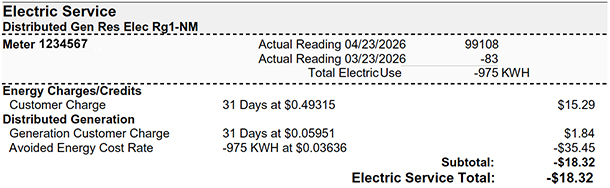
Single bidirectional meter — net generation
When your solar unit generates more energy than you use during the billing month, you receive a credit called Avoided Energy Cost. We pay you for the energy we don’t need to generate from another source.
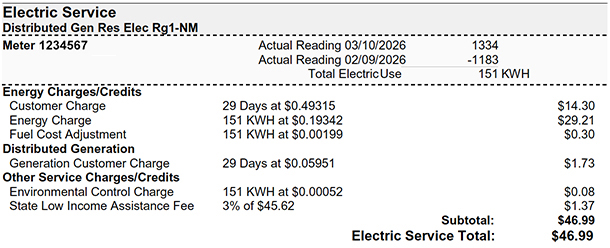
Single bidirectional meter — net consumption
When you use more energy than your solar generation produces in the month, you receive a per kWh energy charge.
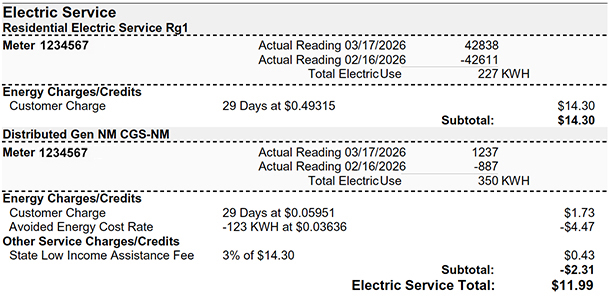
Net metering: 2-meter series
The generation meter in this configuration shows the excess generation you send back to the grid.
In this example, total electric use on the residential meter is 227 kWh. Total electric use for the Distributed Gen meter shows an excess of 350 kWh of generation sent to the grid. To calculate the bill, the two values are subtracted (227 – 350 = -123) and charged at the Avoided Energy Cost rate. The negative number reflects a credit toward your bill.
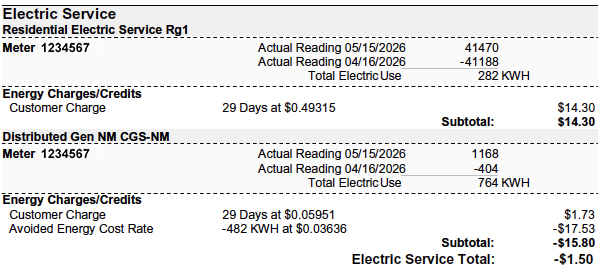
Net generation: 2-meter parallel
The generation meter in this configuration shows the total generation produced.
In this example, total electric use on the residential meter is 282 kWh. Total electric use for the Distributed Gen meter shows total generation of 764 kWh. To calculate the bill, the two values are subtracted (282 – 764 = -482) and charged at the Avoided Energy Cost rate. The negative number reflects a credit toward your bill.