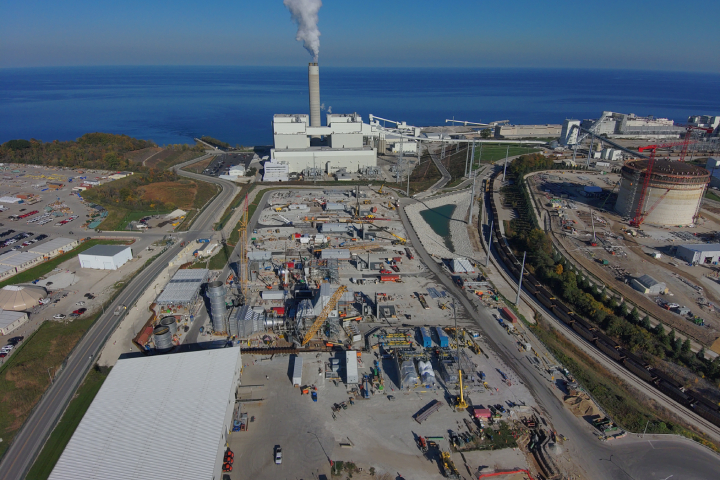
Demonstrated need for LNG
LNG facilities take natural gas from the underground pipeline, when demand and cost are lower, and cool it until it turns to a liquid at -260 degrees F. This reduces the LNG to 1/600th of its original volume, allowing it to be stored in tanks until needed.
During winter, when natural gas demand rises, the LNG is warmed and returned to its vaporous form. It then can be delivered to customers for heating, cooking and other needs, or to a utility like ours to run its generating units.
When Wisconsin service areas saw bitter cold temperatures in winter 2026, our LNG storage facilities in Bluff Creek and Ixonia, Wisconsin, operated consecutively for nine and 10 days, respectively. Approximately 40%-45% of the LNG from each site’s 1-billion-cubic-foot (Bcf) tank was converted back into gas and used, proving how important those investments are in keeping lights on, homes warm and costs down.
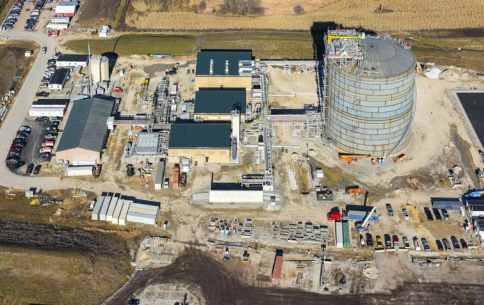
Now, construction of our newest LNG facility is taking shape in Oak Creek. Like the Bluff Creek and Ixonia facilities, it will provide a critical backup to fuel generation and supply during times of peak demand. The site’s 2-Bcf tank will be able to hold 25 million gallons of LNG, equivalent to 38 Olympic-sized swimming pools.